


Analysis of samples from Ryugu and Bennu provides valuable insights into nitrogen chemistry in the early solar system
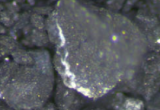
A group of researchers from IAS have identified ammonium-rich (NH₄⁺) phyllosilicates in samples collected at the surface of asteroids Ryugu and Bennu. This is a first for this type of extraterrestrial material. This discovery, published in Nature Communications, demonstrates that ammonium is a key component of nitrogen chemistry for all ‘primitive’ small bodies, whether they are carbonaceous asteroids or comets.
Ryugu and Bennu are two near-Earth asteroids. Both are carbonaceous asteroids; small bodies that are remnants of the early solar system. Studying their composition helps us understand how matter formed, evolved and was distributed throughout the solar system.
Analysis of samples from the asteroids Ryugu and Bennu collected by the Hayabusa2 (JAXA) and OSIRIS-REx (NASA) space missions has led to major advances in this understanding, thanks in particular to a number of unexpected discoveries. Among these, research led by scientists from IAS and involving a broad international collaboration, has just been published in Nature Communications. It has identified, in both collections and for the first time in this type of extraterrestrial material, the presence of phyllosilicates rich in ammonium (NH4+). By investigating the origin of this ammonium and the physico-chemical processes that led to the formation of this particular phase, this discovery makes a decisive contribution to clarifying the history of these small objects and that of the matter that composes them.
The discovery of these ammonium-rich phyllosilicates was made possible by a detailed analysis of the infrared spectra systematically measured on all samples from the Ryugu collection, as well as on a subset of those from the Bennu collection. These samples are all stored at ISAS (Japan) in dedicated facilities, protected from any contact with the Earth’s atmosphere. Thes storage facilities houses the MicrOmega instrument, a near-infrared hyperspectral microscope designed and developed at IAS with the support of CNES. It is operated jointly by teams from IAS and ISAS, and is dedicated to the characterization of all Ryugu and Bennu samples stored at ISAS. The measurements from this instrument are complemented by images with an optical microscope and mid-infrared measurements with a Fourier transform infrared (FTIR) spectrometer.
Analysis of all this infrared data enabled the team to identify the presence of ammonium (NH4+) within a phyllosilicate phase extending over areas of several hundred micrometers and optically brighter than the rest of the very dark phyllosilicate matrix that dominates these two asteroids. The spectral signatures of this mineral assemblage are very similar in both collections, but much more abundant in the Bennu collection than in the Ryugu collection.
This is the second ammonium-bearing mineral phase identified in these two collections of asteroid samples, after the discovery of HAMP(1) inclusions which are hydrated phosphates rich in magnesium and ammonium.,. The detected ammonium is particularly interesting because it is a tracer of a chemical process that began in ices mixed with dust grains in the protosolar disk, in regions necessarily located beyond the current positions of Jupiter and Saturn. Initially in the form of highly soluble ammonium salts (similar to those detected on Comet 67P/Churyumov Gerasimenko) trapped in ices mixed with anhydrous silicates, these ammonium ions were released as a result of the gradual heating of the parent bodies of Ryugu and Bennu and the subsequent process known as ‘aqueous alteration. A new generation of compounds eventually formed: ammonium salts such as HAMP grains which are less soluble in aqueous solution than the first generation of salts, and these silicates, transformed by the action of water and the ammonium it contained into ammonium-rich phyllosilicates.
This discovery thus reinforces the idea that ammonium, whether in the form of salts or phyllosilicates, is a key component of nitrogen chemistry for all these ‘primitive’ small bodies: carbonaceous asteroids and comets. The phases identified in this study may also have played an effective role in delivering this chemically reactive form of nitrogen to the surface of terrestrial planets.
(1) Acronym for “Hydrated Ammonium-Magnesium-Phosphorus-rich grains” [Pilorget et al., Nature Astronomy, 2024 and Pilorget et al., Nature Communications, 2025]
Reference:
Jiang, T. et al. Ammonium-bearing phyllosilicate grains detected in Ryugu and Bennu samples via infrared spectroscopy. Nature Communications, 2026
DOI : https://doi.org/10.1038/s41467-026-72866-y
Contacts : Donia Baklouti et Cédric Pilorget
Press release from Paris-Saclay University : https://www.universite-paris-saclay.fr/salle-de-presse

