
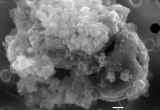
The interplanetary dust particles commonly called IDPs are micrometric extraterrestrial grains (typical size of ten microns). They are collected by NASA’s stratospheric aircrafts (at an altitude of ~ 25 km). Their origin asteroidal and/or cometary has always been a subject of investigation. In recent years we have conducted a systematic analysis of IDPs using infrared micro-spectroscopy through a collaboration with the SMIS beamline at the SOLEIL synchrotron. This work reveals, in one hand, the connection between asteroids/comets and extraterrestrial material collected for laboratory studies, and gives in another hand, valuable information on the relationship between organic matter and mineral phases probably due to physical and chemical processes in the primitive nebula.
You are here
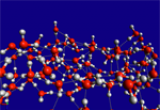
A multidisciplinary team involving researchers from the IAS, the CIMAP, the IPNO, the GANIL, and Rio de Janeiro's PUC Catholic University has characterized in the laboratory the effects of heavy cosmic rays on the structure and sputtering of water ice in interstellar and planetary environments. These experiments are used to study phase changes induced by swift heavy ions, similar to the Galactic cosmic rays. They complement and extend the knowledge already obtained at lower energies. In addition to the ice phase change, these studies reveal the importance of water ice molecules released in the gas phase by swift heavy Galactic ions, or sputtering of interstellar ices present in dense and cold interstellar clouds.
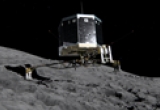
After 7 long months, Philae has awoken from hibernation. Its first signs of life reached Earth on Saturday evening (June, 13th) then again the following night. The hope to see Philae awake again and communicating has just come true.
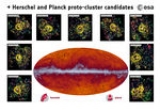
Many new and enigmatic high redshift galaxies that are intensively forming stars have been discovered using ESA’s Planck and Herschel satellites . These galaxies occur in clumps – and could be the long-sought formation phase of galaxy clusters. Some appear very bright, and have been found to be gravitationally lensed galaxies. These rapidly star-forming galaxies could help solve a central problem in cosmology: how did the large scale structure of galaxies form?
A partial solar eclipse will be visible from Orsay, between 9:21am to 11:30am. At maximum at 10:28, about 80% of the Sun will be eclipsed.
Many researchers from IAS will be present in schools. An observation will be possible at IAS with special eclipse sunglasses, with comments from astrophysicists Frédéric Baudin and Clara Froment.