
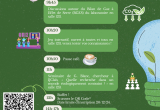
The first "Green Day" at IAS, dedicated to climate change and carbon emissions, took place on Thursday, January 9, 2025. This initiative aims to raise awareness within our community about environmental issues and promote concrete actions to reduce the carbon footprint associated with laboratory activities.
You are here
In line with its values, the IAS has decided to leave the X and Facebook platforms.
Stay tuned to this web page for news about our research and the laboratory's key events.
Thank you for following us.
Best wishes for 2025 from the Institut d'Astrophysique Spatiale !
The electronic greeting card can be found here.
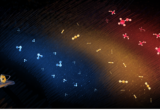
The DiSCo program, thanks to the James Webb telescope, identifies three types of TNOs whose chemical composition, linked to their origin in the protoplanetary disk, sheds light on the formation of planetesimals and the dynamic evolution of the primitive Solar System.
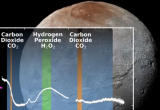
A study in which IAS participated has just revealed the presence of new molecules on the surface of Charon, Pluto's largest moon, thanks to observations from the James Webb Space Telescope (JWST). While a NASA mission, New Horizons, had already mapped this moon in 2015, recent observations by JWST have detected carbon dioxide and hydrogen peroxide on its surface for the first time, enriching our understanding of its chemical composition.