Quiet Sun Transition Region Network

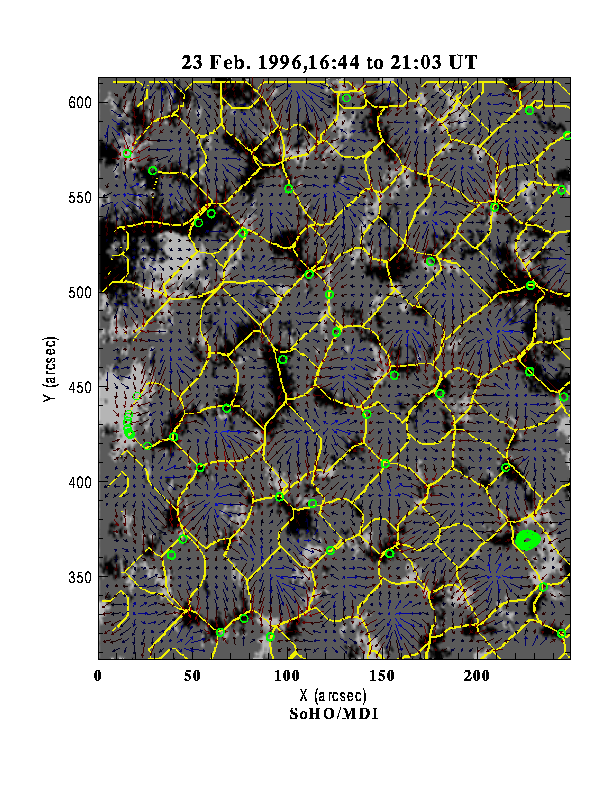
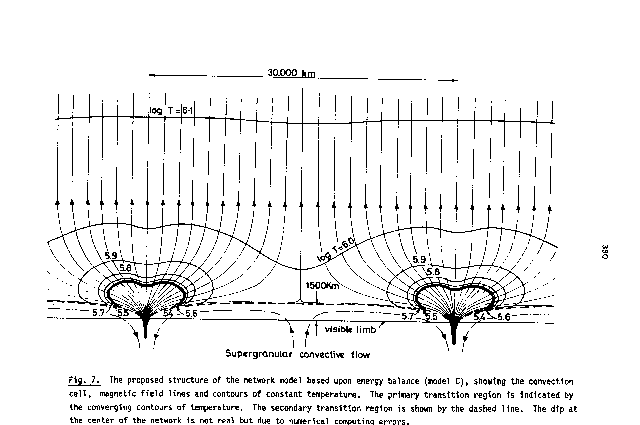
The transition region is believed to be a very thin thermal interface, some hundreds of km in vertical thickness, bridging the chromosphere with the corona and characterized by a 2 orders of magnitude rapid increase of the temperature. The dominant component in the TR is the network which is the upward extension of the super-granular convection cells boundaries. In the above full-disk EIT image (courtesy of the EIT consortium) in the 30.4 nm line of singly ionized Helium, taken not too far from the solar minimum activity, one can easily spot the honey-comb network pattern all over the Sun and occasionaly interrupted by a few active regions and the two Polar Coronal Holes. It is the main building block of the whole solar atmosphere and the basic channel for the energy and momentum that heats the corona and accelerates the solar wind. The network marks the regions where the upward extension of the supergranulation cells penetrates at higher levels in the solar atmosphere and is characterized by magnetic flux concentrations due to the sweeping of flux by convective motions towards its boundaries as shown in the above MDI high resolution magnetogram (courtesy of the MDI consortium) overlaid with lines of convergence of the horizontal flow and with green dots showing the convergence points. The measured flow is shown as colored arrows, red for inferred downflow and blue for inferred upflow. In a 'landmark' paper in 76 A.-H. Gabriel constructed an energy balance model for the Quiet Sun network based on the concept of flux and flow tubes 'funnels' opening with height. By solving the corresponding momentum and energy equations for the given geometry (see below) he found a Differential Emission Measure (D.E.M.) that closely matched with the observations for temperature larger than 100000 K. It was not before the launch of SOHO, that it has been possible to test the geometry employed by Gabriel thanks to its instruments high spatial resolution. A Fourier-based 2D autocorrelation method has been applied to 4 arcmin x 4 arcmin rasters obtained in several transition region lines by the CDS spectrometer on SOHO , in October-November 1997 in the framework of the 2nd MEDOC campaign. The quantitative variation of the network boundary width with temperature has been obtained for the first time in a full 2D field. It appears that network boundaries have an almost constant width, up to a temperature of about 300000 K and then fan-out rapidly at coronal temperatures. This expansion of the transition region network boundaries with temperature is found to be quantitatively in agreement with Gabriel's model (see above). An ApJ article is due to appear in September issue. A similar analysis for a disk coronal hole observed in May 1999 is on its way.

For a preprint, questions, comments etc ......

mailto:spiros@medoc-ias.u-psud.fr