Work progress
(18 january 2015)
Work progress
(18 january 2015)
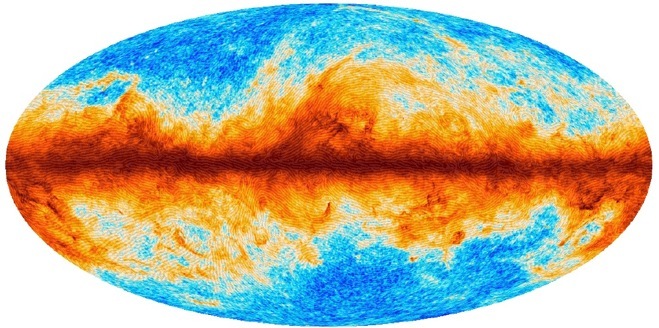
The dusty magnetized ISM as seen by Planck
Planck has produced the first all-sky map of the polarized emission from dust at sub-mm wavelengths. Compared with earlier ground-based and balloon-borne observations (e.g., Benoˆıt et al., 2004, Ward-Thompson et al., 2009, Matthews et al., 2009, Koch et al., 2010, Matthews et al., 2014) this survey is an immense step forward in sensitivity, coverage, and statistics. It provides astrophysicists with new insight into the structure of the Galactic magnetic field and dust properties and provides cosmologists with the first statistical characterization of the main foreground to CMB polarization. The wealth of information that is encoded in the all-sky maps of polarized intensity, P, polarization fraction, p, and polarization angle, ψ, presented in Planck Collaboration C12 (2015) is illustrated in Fig. 1. Here we summarize the main results stemming from the data analysis by the Planck Consortium. The release of the data to the science community at large is expected to trigger many more studies and much more progress.
1 The dust polarization sky
Planck Collaboration Int. XIX (2014) presents an overview of the polarized sky as seen by Planck HFI at 353 GHz, the most sensitive Planck channel for polarized thermal dust emission, focusing on the statistics of p and ψ. At all NH below 1022 cm−2 p displays a large scatter. The maximum p, observed in regions of moderate hydrogen column density (NH < 2 × 1021 cm−2), is high (pmax ≃ 20 %). There is a general decrease in p with increasing column density above NH ≃ 1 × 1021 cm−2 and in particular a sharp drop above NH ≃ 1022 cm−2.
The spatial structure of ψ is characterized using the angle dispersion function S, the local dispersion of ψ introduced by Hildebrand et al. (2009). The polarization fraction is found to be anti-correlated with S. The polarization angle is ordered over extended areas of several square degrees. The ordered areas are separated by long, narrow structures of high S that highlight interfaces where the sky polarization changes abruptly. These structures have no clear counterpart in the map of the total intensity, I. They bear a morphological resemblance to features detected in gradient maps of radio polarized emission (Iacobelli et al., 2014).
2 The Galactic magnetic field
The Planck maps of p and ψ bear information on the magnetic field structure. The data have been compared to synthetic polarized emission maps computed from simulations of anisotropic magnetohydrodynamical turbulence assuming simply a uniform intrinsic polarization fraction of dust grains (Planck Collaboration Int. XX, 2014). The turbulent structure of the magnetic field is able to reproduce the main statistical properties of p and ψ that are observed directly in a variety of nearby clouds, dense cores excluded. The large-scale field orientation with respect to the line of sight plays a major role in the quantitative analysis of these statistical properties. This study suggests that the large scatter of p at NH smaller than ≃ 1022 cm−2 is due mainly to fluctuations in the magnetic field orientation along the line of sight, rather than to changes in grain shape and/or the efficiency of grain alignment.
The formation of density structures in the interstellar medium involves turbulence, gas cooling, magnetic fields, and gravity. Polarization of thermal dust emission is well suited to studying the role of the magnetic field, because it images structure through an emission process that traces the mass of interstellar matter (Planck Collaboration XI, 2014). The Planck I map shows elongated structures (filaments or ridges) that have counterparts in either the Stokes Q or U map, or in both, depending on the mean orientation. The correlation between Stokes maps characterizes the relative orientation between the ridges and the magnetic field. In the diffuse interstellar medium, the ridges are preferentially aligned with the magnetic field measured on the structures. This statistical trend becomes more striking for decreasing column density and, as expected from the potential effects of projection, for increasing polarization fraction (Planck Collaboration Int. XXXII, 2014). Towards nearby molecular clouds the relative orientation changes progressively from preferentially parallel in areas with the lowest NH to preferentially perpendicular in the areas with the highest NH (Planck Collaboration Int. XXXV, 2015). This change in relative orientation might be a signature of the formation of gravitationally-bound structures in the presence of a dynamically-important magnetic field.
The relation between the structure of matter and the magnetic field is also investigated by Planck Collaboration Int. XXXIII (2014), modelling the variations of the Stokes parameters across three filaments for different hypotheses on p. For these representative structures in molecular clouds the magnetic fields in the filaments and their background have an ordered component with a mean orientation inferred from Planck polarization data. However, the mean magnetic field in the filaments does not have the same orientation as in the background, with a different configuration in all three cases examined. Planck Collaboration Int. XXXIV (2015) analyzes the magnetic field in a massive star forming region, the Rosette Nebula and parent molecular cloud, combining Faraday rotation measures from the ionized gas with dust polarized emission from the swept-up shell. This same methodology and modelling framework could be used to study the field structure in a sample of massive star forming regions.
3 Dust polarization properties
Galactic interstellar dust consists of components with different sizes and compositions and consequently different polarization properties. The relatively large grains that are in thermal equilibrium and emit the radiation seen by Planck in the submillimetre also extinguish and polarize starlight in the visible (Martin, 2007). Comparison of polarized emission and starlight polarization on lines of sight probed by stars is therefore a unique opportunity to characterize the properties of polarizing grains. For this comparison, Planck Collaboration Int. XXI (2014) use P and I in the Planck 353 GHz channel and stellar polarization observations in the V band, the degree of polarization, pV , and the optical depth to the star, τV . Lines of sight through the diffuse interstellar medium are selected with comparable values of the column density as estimated in the submillimetre and visible and with polarization directions in emission and extinction that are close to orthogonal. Through correlations involving many lines of sight two ratios are determined, RS/V = (P/I)/(pV /τV ) and RP/p = P/pV , the latter focusing directly on the polarization properties of the grains contributing to polarization. The first ratio, RS/V , is compatible with predictions based on a range of dust models that have been developed for the diffuse interstellar medium (e.g., Martin, 2007, Draine & Fraisse, 2009). This estimate provides new empirical validation of many of the common underlying assumptions of the models, but is not very discriminating among them. The second ratio, RP/p, is higher than model predictions by a factor of about 2.5. A comparable difference between data and model is observed for I/τV (Planck Collaboration Int. XXIX, 2014). To address this, changes will be needed in the optical properties of the large dust grains contributing to the submillimetre emission and polarization.
The spectral dependence in the submillimetre is also important for constraining dust mod- els. In Planck Collaboration Int. XXII (2014) the Planck and WMAP data are combined to characterize the frequency dependence of emission that is spatially correlated with dust emis- sion at 353 GHz, for both intensity and polarization, in a consistent manner. At ν ≥ 100 GHz, the mean spectral energy distribution (SED) of the correlated emission is well fit by a modified blackbody spectrum for which the mean dust temperature of 19.6 K derived from an SED fit of the dust total intensity up to 3000 GHz (100 μm) is adopted. It is found that the opacity has a spectral index 1.59 ± 0.02 for polarization and 1.51 ± 0.01 for intensity. The difference between the two spectral indices is small but significant. It might result from differences in polarization efficiency among different components of interstellar dust. Planck Collaboration Int. XXII (2014) also finds that the spectral energy distribution increases with decreasing frequency at ν < 60 GHz, for both intensity and polarization. The rise of the polarization SED towards low frequency might be accounted for by a synchrotron component correlated with dust, with no need for any polarization of the anomalous microwave emission.
4 Dust foreground to CMB Polarization
The polarized thermal emission from diffuse Galactic dust is the main foreground present in measurements of the polarization of the CMB at frequencies above 100 GHz. The Planck sky coverage, spectral coverage from 100 to 353GHz for HFI, and sensitivity are all important for component separation of the polarization data. Planck Collaboration Int. XXX (2014) measures the polarized dust angular power spectra CEE and CBB over the multipole range 40 < l < 600 well away from the Galactic plane, providing cosmologists with a precise charac- terization of the dust foreground to CMB polarization.
The polarization power spectra of the dust are well described by power laws in multipole, Cl ∝ lα, with exponents α = −2.42 ± 0.02 for both the EE and BB spectra. The amplitudes of the polarization power spectra are observed to scale with the average dust brightness as < I >1.9, similar to the scaling found earlier for power spectra of I (Miville-Deschênes et al., 2007). The frequency dependence of the power spectra for polarized thermal dust emission is consistent with that found for the modified blackbody emission by Planck Collaboration Int. XXII (2014). A systematic difference is discovered between the amplitudes of the Galactic B-and E-modes, such that CBB/CEE = 0.5. These general properties apply at intermediate and high Galactic latitude in regions with low dust column density. The data show that there are no windows in the sky where primordial CMB B-mode polarization can be measured without subtraction of polarized dust emission.
References
Benoît, A., Ade, P., Amblard, A., et al. 2004, A&A, 424, 571. First detection of polarization of the submillimetre diffuse galactic dust emission by Archeops
Cabral, B. & Leedom, L. C. 1993, in Special Interest Group on GRAPHics and Interactive Techniques Proceedings., Special Interest Group on GRAPHics and Interactive Techniques Proceedings., 263–270
Draine, B. T. & Fraisse, A. A. 2009, ApJ, 696, 1. Polarized Far-Infrared and Submillimeter Emission from Interstellar Dust
Hildebrand, R. H., Kirby, L., Dotson, J. L., Houde, M., & Vaillancourt, J. E. 2009, ApJ, 696, 567. Dispersion of Magnetic Fields in Molecular Clouds. I
Iacobelli, M., Burkhart, B., Haverkorn, M., et al. 2014, A&A, 566, A5. Galactic interstellar turbulence across the southern sky seen through spatial gradients of the polarization vector
Koch, P. M., Tang, Y.-W., & Ho, P. T. P. 2010, ApJ, 721, 815. Magnetic Field Proper- ties in High-mass Star Formation from Large to Small Scales: A Statistical Analysis from Polarization Data
Martin, P. G. 2007, in EAS Publications Series, Vol. 23, EAS Publications Series, ed. M.-A. Miville-Deschˆenes & F. Boulanger, 165–188
Matthews, B. C., McPhee, C. A., Fissel, L. M., & Curran, R. L. 2009, ApJ Supp., 182, 143. The Legacy of SCUPOL: 850 μm Imaging Polarimetry from 1997 to 2005
Matthews, T. G., Ade, P. A. R., Angil`e, F. E., et al. 2014, ApJ, 784, 116. Lupus I Observa- tions from the 2010 Flight of the Balloon-borne Large Aperture Submillimeter Telescope for Polarimetry
Miville-Deschênes, M.-A., Lagache, G., Boulanger, F., & Puget, J.-L. 2007, A&A, 469, 595. Statistical properties of dust far-infrared emission
Planck Collaboration C12. 2015, in preparation. A12 Foreground-targeted component separation
Planck Collaboration XI. 2014, A&A, 571, A11. Planck 2013 results. XI. All-sky model of thermal dust emission
Planck Collaboration Int. XIX. 2014, A&A in press, arXiv:1405.0871. Planck intermediate results. XIX. An overview of the polarized thermal emission from Galactic dust
Planck Collaboration Int. XX. 2014, A&A in press, arXiv:1405.0872. Planck intermediate results. XX. Comparison of polarized thermal emission from Galactic dust with simulations of MHD turbulence
Planck Collaboration Int. XXI. 2014, A&A in press, arXiv:1405.0873. Planck intermediate results. XXI. Comparison of polarized thermal emission from Galactic dust at 353 GHz with optical interstellar polarization
Planck Collaboration Int. XXII. 2014, A&A, in press arXiv:1405.0874. Planck intermediate results. XXII. Frequency dependence of thermal emission from Galactic dust in intensity and polarization
Planck Collaboration Int. XXIX. 2014, A&A submitted, arXiv:1409.2495. Planck intermediate results. XXIX. All-sky dust modelling with Planck, IRAS, and WISE observations
Planck Collaboration Int. XXX. 2014, A&A in press, arXiv:1409.5738. Planck intermediate results. XXX. The angular power spectrum of polarized dust emission at intermediate and high Galactic latitudes
Planck Collaboration Int. XXXII. 2014, A&A submitted, arXiv:1409.6728. Planck intermediate results. XXXII. The relative orientation between the magnetic field and structures traced by interstellar dust
Planck Collaboration Int. XXXIII. 2014, A&A submitted, arXiv:1411.2271. Planck interme- diate results. XXXIII. Signature of the magnetic field geometry of interstellar filaments in dust polarization maps
Planck Collaboration Int. XXXIV. 2015, A&A submitted, arXiv:1501.00922. Planck interme- diate results. XXXIV. The magnetic field structure in the Rosette Nebula
Planck Collaboration Int. XXXV. 2015, A&A submitted. Planck intermediate results. XXXV. Probing the role of the magnetic field in the formation of structure in molecular clouds
Ward-Thompson, D., Sen, A. K., Kirk, J. M., & Nutter, D. 2009, MNRAS, 398, 394. Optical and submillimetre observations of Bok globules - tracing the magnetic field from low to high density